
ToF Sensors
Time-of-flight (ToF) sensors measure distance by timing how long emitted infrared light takes to bounce back from the target. DEPZ puts 14 ToF chips on a ready-to-use USB board – from single-zone rangers to lidar-class depth sensors, covering 1 mm to 11 m across the lineup.
| Model | Features description | Resolution | FOV | Max range | Min range | Range in sunlight | Sun rating | Update rate | Multi-target | Motion indicator | CNH histograms | Programmable ROI | Smudge immunity | Chip name | Release year | Chip operating temp | Chip interface | Chip package | Price |
|---|---|---|---|---|---|---|---|---|---|---|---|---|---|---|---|---|---|---|---|
| ToF VL53L0X USBToF VL53L0X USB Module | The simplest and oldest model in the family: one measurement zone, fixed 25° FoV, no advanced processing. Pick it when you just need a basic distance reading. | Single zone | 25° cone | 2 m | 30 mm | ≤ 80 cm | ≤ 50 Hz | — | — | — | — | — | VL53L0X | 2016 | −20…+70 °C | I²C | 4.4 × 2.4 × 1.0 mm | $50 $40 | |
| ToF VL53L1CX USBToF VL53L1CX USB Module | Step up from VL53L0X: 4 m range, faster ranging and a programmable ROI on the receiving array (reduce the FoV or steer it from the host). | Single zone (ROI) | 27° cone | 4 m | 40 mm | — | — | ≤ 50 Hz | — | — | — | — | VL53L1CX | 2017 | −20…+85 °C | I²C | 4.9 × 2.5 × 1.56 mm | $50 $40 | |
| ToF VL53L1CB USBToF VL53L1CB USB Module | Step up from VL53L1CX: the same silicon running ST's histogram firmware — 8 m long-distance mode, multi-object detection, autonomous 2×2/3×3/4×4 sequential-ROI scanning, crosstalk/smudge immunity beyond 80 cm. | 4 × 4 via ROI | 27° cone | 8 m | 40 mm | ≤ 90 cm | ≤ 60 Hz | — | — | VL53L1CB | 2019 | −20…+85 °C | I²C | 4.9 × 2.5 × 1.56 mm | $50 $40 | ||||
| ToF VL53L3CX USBToF VL53L3CX USB Module | Histogram-based multi-target specialist: up to 4 simultaneous targets with accurate distances, immune to cover-glass crosstalk and smudge beyond 80 cm. No zones or ROI — accuracy over flexibility. | Single zone (multi-target) | 25° cone | 3 m | 10 mm | ≤ 100 cm | ≤ 30 Hz | — | — | — | VL53L3CX | 2020 | −20…+85 °C | I²C | 4.4 × 2.4 × 1.0 mm | $50 $40 | |||
| ToF VL53L4CD USBToF VL53L4CD USB Module | Proximity specialist: narrow 18° FoV, linearity down to 1 mm, 100 Hz ranging and an autonomous low-power wake-up mode for battery devices. | Single zone | 18° cone | 1.3 m | 1 mm | ≤ 55 cm | ≤ 100 Hz | — | — | — | — | — | VL53L4CD | 2021 | −30…+85 °C | I²C | 4.4 × 2.4 × 1.0 mm | $50 $40 | |
| ToF VL53L4ED USBToF VL53L4ED USB Module | VL53L4CD re-rated for harsh environments: −40…+105 °C operation and accurate ranging up to 80 cm under 5 klx sunlight. Same 1 mm linearity and 100 Hz. | Single zone | 18° cone | 1.3 m | 1 mm | ≤ 80 cm | ≤ 100 Hz | — | — | — | — | — | VL53L4ED | 2023 | −40…+105 °C | I²C | 4.4 × 2.4 × 1.0 mm | $60 $50 | |
| ToF VL53L4CX USBToF VL53L4CX USB Module | VL53L4CD optics with histogram ranging on top: 6 m max distance, multi-object detection with depth understanding, dynamic smudge compensation (30 Hz). | Single zone (multi-target) | 18° cone | 6 m | 1 mm | ≤ 160 cm | ≤ 30 Hz | — | — | — | VL53L4CX | 2021 | −30…+85 °C | I²C | 4.4 × 2.4 × 1.0 mm | $50 $40 | |||
| ToF VL53L5CX USBToF VL53L5CX USB Module | The first model that outputs a real depth map: 4×4 or 8×8 zones at 63° diagonal, multi-target in every zone, per-zone motion indicator, histogram crosstalk immunity beyond 60 cm. | 8 × 8 zones | 45° × 45° (63° diag) | 4 m | 20 mm | ≤ 170 cm | ≤ 60 Hz | — | — | VL53L5CX | 2021 | −30…+85 °C | I²C | 6.4 × 3.0 × 1.5 mm | $60 $50 | ||||
| ToF VL53L7CX USBToF VL53L7CX USB Module | VL53L5CX with ultra-wide metasurface optics: 60°×60° (90° diagonal) coverage. The trade-off: max range drops to 3.5 m and sunlight range to ~65 cm (vs 170 cm). Pin- and driver-compatible with VL53L5CX. | 8 × 8 zones | 60° × 60° (90° diag) | 3.5 m | 20 mm | ≤ 65 cm | ≤ 60 Hz | — | — | VL53L7CX | 2022 | −30…+85 °C | I²C | 6.4 × 3.0 × 1.6 mm | $60 $50 | ||||
| ToF VL53L7CH USBToF VL53L7CH USB Module | VL53L7CX plus CNH histogram output for on-device AI (up to 64 zones, 128 bins per zone, 30 Hz) — everything else identical to VL53L7CX. | 8 × 8 zones | 60° × 60° (90° diag) | 3.5 m | 20 mm | ≤ 65 cm | ≤ 60 Hz | — | VL53L7CH | 2023 | −30…+85 °C | I²C | 6.4 × 3.0 × 1.6 mm | $65 $55 | |||||
| ToF VL53L8CX USBToF VL53L8CX USB Module | VL53L5CX next generation: 285 cm ranging under 5 klx sunlight (vs 170 cm), ~3× lower power, SPI up to 3 MHz, works behind dark cover glass. | 8 × 8 zones | 45° × 45° (65° diag) | 4 m | 20 mm | ≤ 285 cm | ≤ 60 Hz | — | — | VL53L8CX | 2022 | −30…+85 °C | I²C, SPI | 6.4 × 3.0 × 1.75 mm | $60 $50 | ||||
| ToF VL53L8CH USBToF VL53L8CH USB Module | VL53L8CX plus CNH histogram output for on-device AI (up to 64 zones, 128 bins per zone, 30 Hz) — everything else identical to VL53L8CX. | 8 × 8 zones | 45° × 45° (65° diag) | 4 m | 20 mm | ≤ 285 cm | ≤ 60 Hz | — | VL53L8CH | 2023 | −30…+85 °C | I²C, SPI | 6.4 × 3.0 × 1.75 mm | $65 $55 | |||||
| ToF TMF8829 USBToF TMF8829 USB Module | From 64 to 1536 zones: 48×32 depth pixels at 15 Hz, 8×8 at 30 Hz out to 8 m, 11 m maximum reach, 80° FOV, up to 4 objects per pixel and a 1 cm minimum distance; 1.4 m at 5 klx sunlight on a grey target. The multi-lens-array optics make it the widest and longest-reaching dToF in the range. | 48 × 32 zones | 80° diag (4:3) | 11 m | 10 mm | ≤ 137 cm | ≤ 30 Hz | — | — | — | TMF8829 | 2025 | −40…+85 °C | I²C / I³C, SPI 16 MHz | 5.7 × 2.9 × 1.5 mm | $90 $80 | |||
| ToF VL53L9CX USBToF VL53L9CX USB Module | ST's 3D lidar module: 2268 zones (54 × 42), 8.8 m reach, 100 Hz, 55° × 42° FOV, depth + IR + reflectance + confidence maps, multi-object detection per zone, 8 m in 5 klx and 3 m in 100 klx. The highest-resolution, fastest and most sunlight-robust ToF of the range — the step beyond the VL53L8. | 54 × 42 zones | 55° × 42° (71° diag) | 8.8 m | 50 mm | ≤ 800 cm | ≤ 100 Hz | — | — | — | — | VL53L9CX | 2025 | −30…+70 °C | I²C 1 MHz / I³C 12.5 MHz control, MIPI CSI-2 data | 12.83 × 6.10 × 4.64 mm | $120 $110 |
Types of ToF sensors
Single-zone ToF rangers
Single-zone ToF rangers give one distance per measurement over a narrow cone. The simplest choice for presence detection, level sensing and distance to a wall or object. Some chips report several targets per reading or let you move the region of interest (ROI) inside the field of view.
Multizone ToF sensors
Multizone ToF sensors measure a grid of independent zones in every frame – a coarse depth map instead of a single number. Used for obstacle avoidance, people and gesture detection, and for finding where an object is, not only how far it is. The CH versions also output raw histograms for on-device AI.
Lidar-class ToF sensors
Lidar-class ToF sensors return hundreds to thousands of zones per frame – a real low-resolution depth image. These 3D ToF sensors are made for mapping, robot navigation and 3D scene understanding where a multizone grid is too coarse.
How to choose a ToF sensor
- Start with the answer you need: one distance (single-zone), where things are in front of the sensor (multizone), or the shape of the scene (lidar-class).
- Check the range against both your farthest and your closest target. The maximum is the chip vendor's figure for good conditions; dark targets and strong ambient light shorten it, so keep a margin.
- A narrow cone measures one spot; a wide field covers more of the scene with the same number of zones, so each zone sees a larger area.
- On multizone parts the frame rate trades against resolution: the 4×4 mode runs faster than 8×8. For fast-moving targets, pick the rate first – per-mode rates are on each product page.
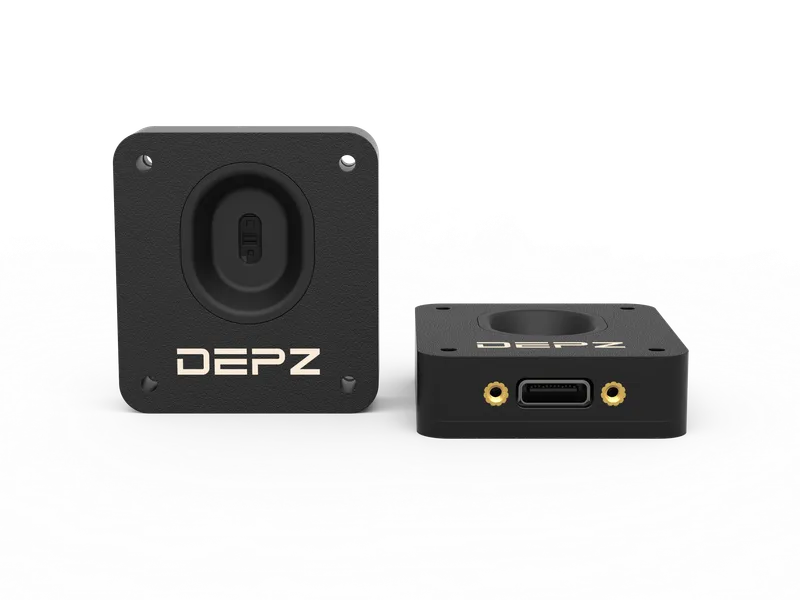
- Take the Sensor for a desk, a robot or a tripod; take the Module to build the board into your own enclosure. Both connect over USB-C and use the same software.
Every model comes in two forms on the same USB-C board: the Sensor in a compact plastic enclosure, and the Module – the bare board for building into your own housing.
The board appears as a virtual COM port (USB CDC), so no driver is needed. Read it with the open-source DEPZ sensor SDKs (Python, JavaScript, C#, Java, C, C++, Rust) or look at live data in the Sensor Viewer.